

CHECK IN WITH A MATERIAL ADVANTAGE.
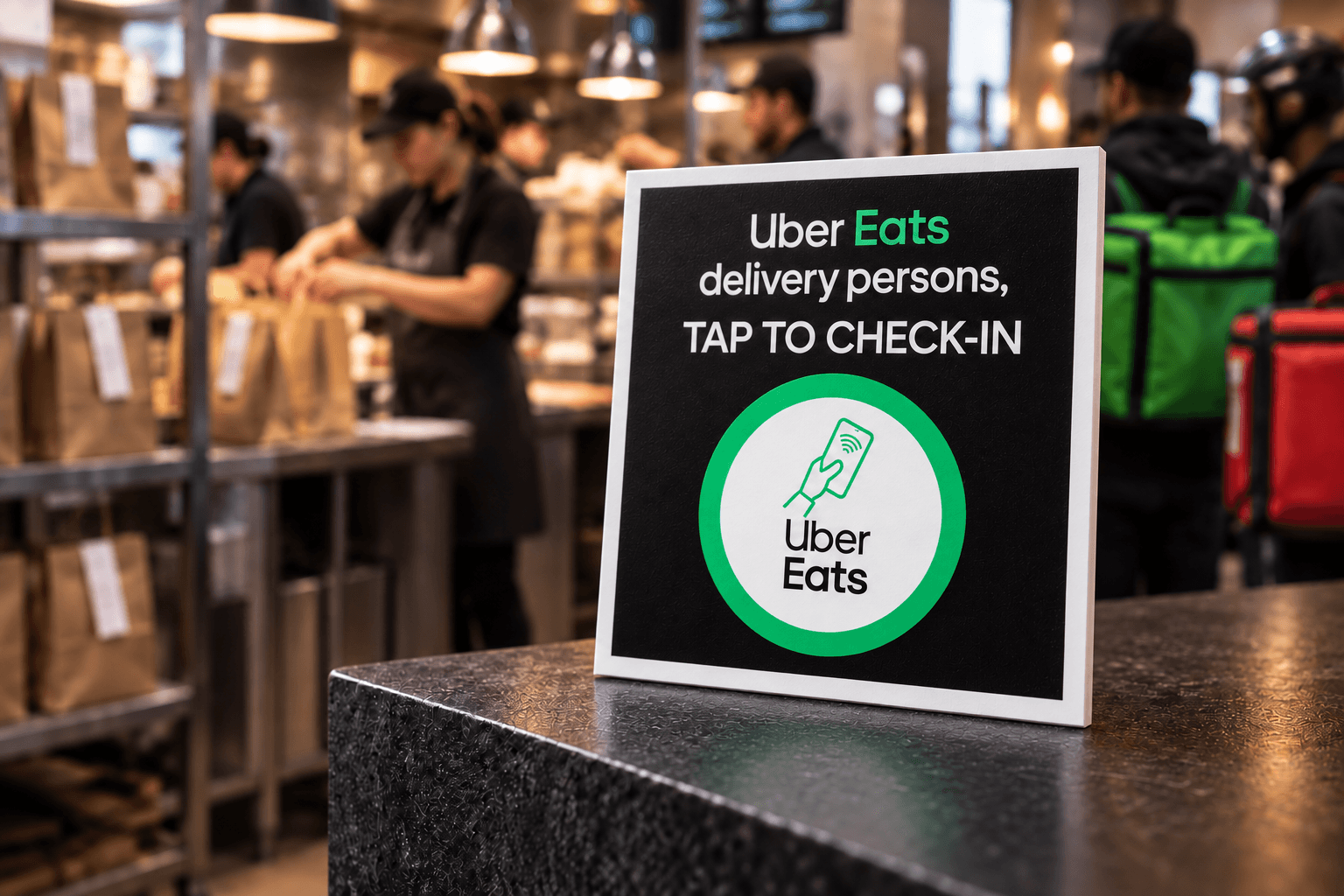
Durable HDPE. Permanent graphics. Protected NFC. One interface designed for busy restaurants, indoors and out.
Explore the interface
Peel. Stick. Tap.
Built to remain mounted, readable, cleanable and functional through years of restaurant use.
Pre-applied mounting. Protected NFC. Peel. Stick. Tap.
Permanent identification. Protected NFC. Pre-applied mounting. Built for repeated cleaning.
A durable HDPE body for indoor and outdoor locations.
The digital system begins with a durable physical interface.
Courier arrives → taps the interface → the check-in event is created → Uber receives the data → the system improves.
CHOOSING THE PHYSICAL SYSTEM
One design for all operating environments.
Printed metal. Printed PVC. Or one HDPE interface engineered for indoor counters, kitchens, exterior walls and drive-through collection points.
HDPE + permanent graphic
One indoor/outdoor design.
NFC configured for the application.
Cleanable, permanent identification.
Metal + Print
Durable metal body.
On-metal NFC provision.
Separate graphic to protect.
Printed PVC
Lower initial cost.
Printed surface subject to UV, cleaning and wear.
Replacement may be required over time.
One inventory. One installation method.
One indoor-outdoor design means fewer versions to forecast, stock and distribute. The plaque, permanent graphic, NFC and mounting system can be qualified and improved as one product.
The lowest initial price is not the lowest lifetime cost.
SIMPLICITY DELIVERS STABILITY
Three components. One complete interface.
A durable HDPE plaque with permanent graphics. A recessed NFC assembly. Pre-applied adhesive mounting. Each part works with the next.

HDPE plaque

NFC + mounting
Open Production Drawings
Current samples
The samples bring the complete interface together: a durable plaque with permanent graphics, a tap-to-check-in chip beneath a protective layer, and two mounting strips already applied. The strips leave the chip area clear so you can evaluate installation and tap performance together at your locations.
View All drawings and datasheets
TESTED FOR ITS LIVED LIFE
Designed to exceed specification. Supported by evidence.
Polymer Fusion technology has been proven across demanding applications including GM, Ford and Honda automotive interior and under-hood components with 15-year service-life requirements, Fisher & Paykel dishwashers, YETI coolers, Strider bikes, Stericycle medical-waste containers, chemical-storage products, protective cases and other long-life polymer applications expected to endure demanding environments. That experience is why we engineered the Uber Courier Check-In Tag to exceed its intended service requirements—not simply meet them.
What other Courier Check-In Tag is built to take on all of this?

Designed for the environment
A cleanable HDPE body for indoor counters, kitchens and outdoor collection points.

Existing performance evidence
Permanent identification tested against demanding service conditions.

Complete-system evaluation
Mounting, readability and NFC performance to be validated together in representative locations.

Made for the working day.
Hands, phones, grease and weather. A small interface with a demanding job.
Explore the testing data ↓
Grease. Weather. Daily wear.
Still working.


MADE TO GET CLEAN AGAIN
Remove the graffiti. Not the identity.
Grease, marker and unwanted stickers meet a surface designed for cleanup. The required graphic stays part of the plaque.

Before cleaning
Marker, grease and unwanted stickers.

After cleaning
Clear identification. Ready for the next tap.
Clean it. Check it. Tap again.
Field validation before scale.
Polyfuze and Identiv are prepared to support production-intent field evaluation in representative Uber locations prior to full deployment. The objective is to evaluate the complete Courier Check-In Tag system in everyday service and confirm the final production architecture before scale.
10-YEAR TOTAL COST OF OWNERSHIP
Price is measured on day one. Total cost accumulates over time.
A three-tag kit provides three durable Courier Check-In interfaces from a common indoor/outdoor architecture. The purchase price is only part of the equation. Replacement tags, repeat installation and additional shipments all contribute to the cost of keeping a check-in system working.
Final pricing will reflect confirmed production volume and deployment requirements. Service life and replacement timing remain planning assumptions, not guarantees.
What drives lifetime cost
STILL WORKING. NOW IT’S YOUR TURN.
Still doing the job.
Use it. Clean it. Get it wet. Then tap it again.
A reliable arrival signal begins with a physical interface Uber can trust. The event creates the evidence. The evidence improves what happens next.
Questions
ENGINEERED FOR THE EVERYDAY
Go deeper.
The main story is simple. The supporting engineering is here when you want it. Explore the evidence, current samples and proposed production options.
Price is measured on day one. Total cost accumulates over time.
Each restaurant receives three Courier Check-In interfaces built around the same indoor/outdoor architecture. The comparison is about keeping the complete interface mounted, readable, cleanable and NFC-functional over its service life—not simply keeping a substrate on the wall.
Model assumptions
Final Courier Check-In Tag pricing is driven by production volume. As deployment scales, unit economics improve; final total-cost comparisons should therefore be based on the approved production volume and deployment plan.
Replacement timing is a planning assumption, not a claimed lifespan. The included spare absorbs the first failure; purchased replacements follow.
Polyfuze is modeled without a replacement during the comparison period.
A replacement event includes more than the replacement interface itself. Fulfillment, freight, handling, installation and administrative coordination all contribute to lifecycle cost.
An educated planning estimate—not a claim that every interface fails on the same day. Common initial shipping and packaging are excluded. Estimates are not a final quotation or a guarantee of complete-system service life.
What drives replacement?
UV exposure, fading, surface wear, staining and permanent defacement can contribute to replacement over time.
Moisture, humidity and temperature cycling can affect the graphic and adhesive. Edges can lift, print can fade, and defacement can force replacement.
Graphic and plaque function as one material system. Mounting, NFC performance and extraordinary damage remain complete-system considerations.
The substrate may remain on the wall after the interface has failed. That is not continued performance.
Production economics
Initial unit price is only one component of lifecycle cost. Courier Check-In Tag pricing varies with production volume, while replacement-based alternatives create additional product, fulfillment, freight and installation costs over time.
| System | Initial cost | Service consideration |
|---|---|---|
| Printed PVC | Lower initial cost | Higher replacement exposure |
| Metal + applied graphic | Moderate initial cost | Graphic and adhesive dependent |
| Polyfuze HDPE | Volume dependent | Designed for long-term service |
Replacement events change the economics.
A lower initial purchase price can be quickly offset when a complete replacement kit must be produced, fulfilled, shipped and reinstalled. The more replacement events required over the service period, the greater the lifecycle-cost difference becomes.
Day-one price does not determine lifecycle value.
Lower-cost alternatives may reduce the initial purchase price, but each replacement introduces another product purchase, shipment, installation event and period of operational disruption. As production volume increases, Polyfuze unit economics also improve, strengthening the lifecycle comparison.
Replacement frequency drives ten-year cost.
Under the model’s replacement-cycle assumptions, repeated purchases can erase the initial price advantage of lower-cost alternatives. The appropriate comparison is accumulated cost over the intended service period, not simply the first purchase price.
Total cost of ownership is a much better analysis of value.
The costs not shown
Every replacement also requires Uber to:
- Detect or receive notice of the failure.
- Identify the correct restaurant and process the replacement.
- Package and ship another interface.
- Coordinate installation and remove or cover the failed unit.
- Confirm that the new NFC interface works.
- Manage the brand impact of peeled, faded or discolored graphics.
During that process, the restaurant may have an interface that is unreadable, unusable or no longer producing dependable courier-arrival data.
Those costs are excluded from the simplified comparison. They are not excluded from Uber’s operation.
Theft and extraordinary damage are assumed equal across options and excluded. The complete Polyfuze assembly remains subject to system-level validation.
The job is not to keep a plaque on the wall.
The job is to keep the interface working.
Polyfuze is the lower-risk, better-value design.
Drawings and datasheets
Choose the build you are reviewing. Current-sample documents describe the evaluation hardware. Proposed-production documents outline the next configuration and NFC choices.
Current samples
Evaluation hardware supplied for review.
Proposed production
Not released. Final configuration subject to evaluation and approval.